
Disclaimer
This playbook describes what other operators did and what published guidance says. It is not legal, medical, insurance or safety advice, and we are not responsible for the outcome of any decision you make using it. Laws on tenancy, abandoned property, evictions and cleanup vary by state and change often. When someone is hurt, when police are involved, or when real money is at stake, get advice from a professional licensed where your property is. Every case in Section 4 is a composite drawn from public accounts; no real guest, host or booking is identifiable.
How to use this
There is one rule in this whole document, and everything else follows from it. Answer fast, decide slowly.
Almost every problem a guest brings you has two parts: the feeling and the fix. The feeling is urgent and cheap to handle: it costs you one message in the next five minutes. The fix is often slow and sometimes expensive, and it is almost never improved by hurrying.
Hosts get this backwards. They go quiet while they work out what to do, then arrive two hours later with a solution and an apology, to a guest who has already decided how they feel about the stay. The review was written in that silence.
So: reply now, decide tomorrow. Section 1 is how you decide. Section 3 is what to send while you are deciding. Section 4 is for the nights when neither applies.
Keep this on your phone, not in a drawer. The parts you will actually need at 11pm are Section 3 and the escalation card.
The escalation system
“Answer fast, decide slowly. That is the whole document.”
Four levels, three lines, one number. That is the whole system, and it fits on the one-page card below.
Sort it before you answer
Every problem is one of four levels. Sorting takes ten seconds and it tells you two things: how fast to reply, and how much you are allowed to decide on your own.
| Level | What it means | Reply within | Who decides |
|---|---|---|---|
| 1 · Annoyance | Guest is unhappy. Nothing is broken or unsafe. | 1 hour | You |
| 2 · Disruption | Something they paid for doesn’t work. | 30 min | You, to your limit |
| 3 · Harm | Someone is hurt or unsafe, or the money is now large. | 15 min | You, then the owner |
| 4 · Catastrophe | Death, fire, crime, police, press. | Now | Emergency services first |
Most problems are Level 1 or 2. If you treat everything as a Level 3 you will burn out inside a season and give away money you never needed to give away.
The three-line first reply
Your first message has three lines and no more:
- I have read this.
- Here is what I am doing right now.
- Here is when you will hear from me next.
No apology paragraph. No explanation of why it happened. No money. If you cannot fix it yet, send the three lines anyway. A guest who hears nothing for two hours writes a different review from one who heard in five minutes and then waited two hours.
Never name the number first
The moment you say “I can refund you $80”, eighty dollars is the floor and the conversation starts climbing. Fix the problem first. Money is tomorrow’s conversation, when the guest is no longer angry and you know what it actually cost.
But you do need a number of your own: the amount you can give away without asking anybody. Pick it today and write it down. Without a limit, every decision travels to the owner and every reply is slow, and slow is the thing that costs you.
Reply now, decide tomorrow. Almost nothing you owe a guest has to be decided in the next ten minutes. The reply is the exception.
Evidence before negotiation
Photograph, timestamp, and keep everything in the platform’s message thread. Not because you expect a fight, but because the one time you do, the person with dates and pictures wins and the person with a good memory does not. Move a conversation to WhatsApp and you have thrown your evidence away.
The handover
Every problem ends in one of three places: you fixed it, you paid for it, or you passed it on. Passing it on is a real outcome and it needs to be explicit: who now owns it, what they have been told, and when you will check. Problems that get half-passed are the ones that come back as reviews.
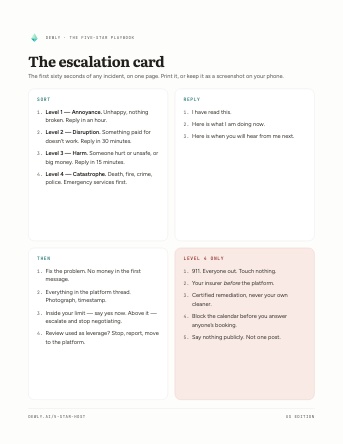 Resource · PDF · one pageThe escalation cardThe whole system compressed to the first sixty seconds. Print it, or keep it as a screenshot on your phone.
The self-audit
“Every ‘no’ here is a night you will lose later.”
Answer honestly. Every “no” here is a night you will lose later, and most of them take under ten minutes to turn into a yes.
If your phone died right now, could someone else answer a guest?
If no: write down your lock codes, cleaner’s number and platform login, and give them to one other person today. Section 3, Bank 1 exists because of this question.
Do you know your refund limit, the number you can give without asking anyone?
If no: pick one now. Any number. Without it, every decision travels and every reply is slow.
Is every guest conversation inside the platform thread?
If no: move them back. A conversation on WhatsApp is evidence you no longer have.
Do you know what your insurance actually covers, not what you assume?
If no: call your broker and ask specifically about biohazard remediation, loss of income, and guest injury. Do it before you need the answer.
Could you reach a certified biohazard remediation company tonight?
If no: find one now and save the number. Your regular cleaner is not this, and using them can void the claim.
Do you know your state’s threshold for a guest becoming a tenant?
If no: find out before you accept another long booking. Many experienced operators cap stays below 30 days so the question never comes up.
Have you tested your own lock, from outside, in the last month?
If no: do it this week. Lockouts are the most preventable late-night message you will get.
Does your cleaner know what to do if they find something serious?
If no: tell them: stop, don’t touch anything, call you, don’t go back in. Then tell them you will pay them for the visit regardless.
Do you have a rehousing option you could book in five minutes?
If no: pick two nearby places now and save them. Half this playbook depends on moving a guest quickly.
Do your neighbours have your phone number?
If no: give it to them. A neighbour who calls you is worth ten who call the council.
Do you photograph the property after every clean?
If no: start. Timestamped photos settle damage claims that arguments never will.
Have you ever had to call the platform twice about the same thing?
If yes: that is normal, and worth knowing. Front-line support and specialist teams are different people. Plan for two calls.
Is there anything in the property you have been meaning to fix for over a month?
If yes: that is the thing the review will be about. It always is.
Have you taken the free trafficking-awareness training?
If no: it is under an hour, it is free, and it is the one item on this list where being unprepared has consequences beyond your business.
When did you last have a full day where you were not reachable?
If you can’t remember: that is the finding. Everything else on this list is fixable in an afternoon. This one is the reason hosts quit.

The twenty most common situations
“A guest who hears nothing for two hours writes a different review from one who heard in five minutes.”
These are deliberately ordinary. Twenty situations cover the overwhelming majority of everything a guest will ever bring you, and none of them are dramatic.
Square brackets are yours to fill. Every message assumes you send it in the platform thread, not by text.
Before they arrive
The booking confirmation that prevents half of this list
Use when: every booking, within an hour of it landing.
Hi [name], thanks for booking, and welcome. Check-in is any time after [time], and I’ll send door codes and directions the day before. Two things worth knowing now: [the one quirk: parking, stairs, the gate]. If anything comes up before or during your stay, message me here and I’ll sort it. Looking forward to having you.
- Name the quirk that generates your most common complaint. Parking, stairs, a steep drive, no lift.
- Say where to reach you once, so they never look for your phone number.
Don’t paste your full house rules here. Nobody reads them, and it sets a tone of suspicion before they have arrived.
The day-before message
Use when: 24 hours out, every stay, without exception.
Hi [name], you’re in tomorrow. The address is [address], the door code is [code], and here’s how to find it: [one line]. Check-in from [time]. Message me here if anything’s unclear when you arrive. Safe travels.
- Code and address in the same message. Not in two, not in a link, not in an attachment.
- This is the message that prevents entries 5 and 6 on this list.
Early check-in request
Use when: they ask to arrive before your turnaround is done.
Hi [name], that should be fine. The place will be ready from [realistic time]. I’ll message you the moment it’s clear rather than have you waiting outside.
Hi [name], sorry, I can’t do earlier this time. The cleaners are in until [time]. You’re welcome to drop bags at [option] if that helps, and I’ll let you know if it’s ready sooner.
Don’t promise a time your cleaner has not confirmed. A broken early check-in is worse than a refused one.
Late checkout request
Use when: they ask to stay past checkout.
Hi [name], no problem at all, take until [time]. Just pull the door shut when you go.
Hi [name], I wish I could, but I have guests arriving today and the cleaners are tight as it is. Checkout needs to be [time]. Happy to help with luggage or a taxi if that makes the day easier.
- Free when it costs nothing, firm when it costs something. Inconsistency is what breeds the argument.
Arrival
They can’t find the property
Use when: they are nearby, lost, and usually tired.
Hi [name], sorry, it’s a tricky one to spot. [Landmark], then [direction]. The door is [description]. If you’re still stuck in two minutes, call me on [number] and I’ll talk you in.
- Give a landmark, not a map link. They already have the map; it is the map that failed.
- Offer the phone early. Typing directions to a lost person in a car is cruel.
Guest is locked out
Use when: the code fails, the key is missing, the door won’t open. Usually late.
Hi [name], I’ve got this. Try [code] once more, slowly, and press the lock button after. If that doesn’t work, [person] is on the way and will be there by [time]. I’ll stay on this message until you’re inside.
- Check the lock remotely before you send anything. Half of these are a dead battery you can see from your phone.
- Send someone if you can’t see it. Don’t have the guest debugging for twenty minutes.
- Stay in the thread until they are in. Then ask again in the morning.
Don’t say “the code works for everyone else”, and don’t offer money tonight. Past an hour this is a Level 2. Book them a room and settle up after.
They arrive to a cleaning miss
Use when: it is untidy or something was missed, not the Section 4 version.
Hi [name], that’s not the standard I hold, I’m sorry. Two options: I can have someone there within [time] to put it right, or if you’d rather not have anyone in the space this evening, I’ll sort it tomorrow and take [amount] off the stay. Your call, just tell me which.
- Offering the choice is the whole trick. It hands control back to someone who has just lost it.
Don’t blame the cleaner by name, and don’t ask the guest to photograph it before you will act.
They arrive early and it isn’t ready
Use when: they turn up before check-in unannounced.
Hi [name], I can see you’re there early. The cleaners are still in and it won’t be ready until [time]. [Nearby café/bag drop] is two minutes away if you want to wait somewhere comfortable. I’ll message you the second it’s clear.
- Name a specific place to go. “Come back later” is what starts the bad review.
During the stay
No hot water, heat or air conditioning
Use when: something essential to comfort has failed. This is a Level 2, always.
Hi [name], sorry about that. Two quick things to try: [reset step]. If that doesn’t do it, I have [engineer] coming [time]. And if it can’t be fixed today I’ll move you rather than have you spend a night without it.
- One reset step, not five. You are not making them your engineer.
- Say the rehousing option out loud. Knowing it exists is most of the reassurance.
- In winter, no heat is a habitability question, not a comfort one. Move them.
The wifi is down
Use when: no internet. Treat as Level 2. A working guest with no wifi has lost the reason they booked.
Hi [name], sorry. Please try unplugging the router at [location] for thirty seconds and plugging it back in. It takes about two minutes to come back. If it’s still down, tell me and I’ll get [provider] on it and sort you a hotspot in the meantime.
- Keep a mobile hotspot in the property if you take business travellers. It costs less than one refunded night.
Something is broken
Use when: an appliance, a TV, a shower door.
Hi [name], thanks for telling me, and sorry. I’ll have [person] look at it [when]. Will [time window] work for you, or would you rather they came when you’re out?
- Always ask before sending anyone into the property. Entry without agreement is its own complaint.
Don’t ask whether they broke it. Not now. Fix first; that conversation is for after checkout, if at all.
A neighbour complains about noise
Use when: the complaint comes from outside the booking. Move fast. Neighbours end businesses.
Hi [name], I’ve had a noise complaint from a neighbour. I’m not accusing anyone of anything, but I do need it quiet from now, especially after [time]. The building is strict and it puts the listing at risk. Thanks for understanding.
Thanks for telling me, and sorry. I’ve messaged them and it should settle in the next few minutes. If it doesn’t, call me on [number], any time, genuinely.
- Reply to the neighbour first. They are the relationship that outlasts the booking.
Your guest complains about noise
Use when: building works, a party next door, traffic.
Hi [name], sorry, that sounds miserable. [What you can actually do: call the neighbour, contact the building, ear plugs in the drawer.] If it carries on past [time] tonight, tell me and I’ll look at moving you.
- Don’t defend the neighbourhood. You cannot win an argument about how loud a street is.
A pest: ants, mice, a wasp nest
Use when: they report something living in the property.
Hi [name], thanks for telling me and I’m sorry. I’ve booked [pest company] for [time]. If you’d rather not stay in the meantime, say so and I’ll move you tonight, no argument.
- Professional treatment, not a shop-bought spray. A guest who watches you improvise loses confidence entirely.
- Anything biting: move them the same night and treat it as Section 4, Scenario 3.
Fix the problem first. Money is tomorrow’s conversation, when the guest is no longer angry and you know what it actually cost.
Money and friction
A small refund request
Use when: something went wrong, they want money, and the number is inside your limit.
Hi [name], you’re right that [problem] shouldn’t have happened, and I’m sorry. I’ve refunded [amount], which should be with you in a few days. Thanks for being straightforward about it.
- Inside your limit, say yes immediately and completely. A fast small yes prevents a slow large one.
Don’t negotiate below your own limit to save fifty dollars. That is how a Level 1 becomes Section 4, Scenario 7.
Damage found after checkout
Use when: your cleaner finds something broken or missing.
Hi [name], hope you got home fine. My cleaner found [damage] this morning. I’m not assuming anything went wrong deliberately, these things happen, but I do need to sort the repair. It’s [amount]. Can you let me know here?
- Photos with timestamps, taken before anything is cleaned or moved.
- Message the same day. A claim that surfaces a week later is a claim nobody believes.
- Ask directly first, claim through the platform second.
Don’t mention the review in any part of this. Ever, in either direction.
More people than were booked
Use when: the neighbour, the doorbell or the cameras say six, and the booking says two.
Hi [name], I think there are more people at the property than the booking covers. That matters for insurance more than anything else. Can you update the booking to [number]? It’s [amount] extra and takes a minute.
- Lead with insurance. It is true, it is unarguable, and it isn’t an accusation.
A party, in progress
Use when: it is happening now. Level 3, and it can become Level 4 quickly.
Hi [name], I know there’s a gathering at the property. It needs to end tonight and the extra guests need to leave. I’m not going to argue about it over messages. Please confirm here that it’s being wound up.
- Do not go alone. Not to reason with them, not to look.
- Police for noise or safety, platform for the booking, in that order.
- Photograph the outside only. Never enter a party to gather evidence.
- Warn the neighbours yourself before they hear it from someone else.
Afterwards
A bad review has been posted
Use when: it is public and you are angry. Wait a day. Then write.
Thanks for the feedback. [Problem] did happen and I’m sorry it affected the stay. [What has changed since.] I hope you’d give us another go.
- You are writing for the next reader, never for the reviewer. They are gone.
- Three sentences. Long defensive replies do far more damage than the review did.
- Only report it if it breaks a specific platform rule. “It’s unfair” is not grounds.
Don’t correct their facts point by point. Everyone reading takes the guest’s side in a long argument.
A review used as leverage
Use when: “refund me or I’ll leave a one-star.” This ends the direct conversation.
Hi [name], I’m still happy to sort this out, and I’d rather do it through [platform] so we both have a record. I’ve opened a case there and you’ll hear from them shortly. Please leave whatever review reflects your stay.
- Report it. On most platforms this breaks the rules and reporting is your only real protection.
- Say the last line and mean it. Fear of the review is the whole leverage; give it away and you have none to lose.
Don’t pay. It is usually against platform rules, it rarely stops the review, and it marks you as someone who pays.
The eight nightmares
“The hard problem is not the body, and it is not the cleaning. It is that you will be asked to pay five figures upfront.”
Eight things most hosts never face. A few will face one. The first hour is what this section is for, and in nearly every scenario the first hour is about money and safety, not about the guest.
If you are reading this tonight because something has happened: find your scenario, work down the steps, and ignore everything else on the page.
Injury or death
Most hosts never open this section. A few will open it once. If you are reading it tonight, work down the steps and don’t read the rest of the page.
Seven things fall in this scenario: a guest is seriously hurt, a guest dies during the stay, a guest dies before arrival, a guest takes their own life, a death caused by something unsafe on the property, a death that becomes a police matter, and the one nobody plans for: the host or co-host dies while guests are in the house. The first hour is nearly the same for all of them. They split after that, and they split on money.
Here is the part that surprises everyone. The hard problem is not the body, and it is not the cleaning. It is that you will be asked to pay five figures upfront. One host was quoted $2,500 just for the cleaners to attend, with a final bill estimated at $15,000 to $25,000. She asked the platform for a claim number so the company could bill them directly. She was told to pay it herself and claim it back. Thirty days later she had no reimbursement, no income and no reply.
That is why the money calls happen in hour one, not next week.
What to do first, in every case
In order. Don’t skip ahead to the money.
- Call 911. Even if it is obvious the person has died. You do not make that determination.
- Get everyone else out. Other guests, cleaners, anyone due to arrive. Send them somewhere and pay for it. Sort the cost out later.
- Touch nothing. Clean nothing. Not the room, not the bedding, not “just tidying up.” This is not squeamishness. It is money. See step 6.
- Do what the police tell you and nothing more. They may seal the property. That can last days, and you have no say in it.
- Call your own insurer. Your policy, your broker, your agent. Before the platform. Get a claim number from them. This is the step almost everyone misses and it is the one that pays.
- Call a certified biohazard or trauma remediation company. Not your cleaner. Not a general contractor. If you use a normal cleaner, your insurer can refuse the entire claim.
- Now call the platform. Report the death. Ask what they cover, and get it in writing in the message thread, not on the phone.
- Block the calendar. Before you deal with anyone’s booking. You don’t yet know how long you are out.
Don’t
- Post about it, anywhere, including in host groups.
- Name the guest, to anyone.
- Speak to a reporter.
- Answer neighbours beyond “there has been an incident and the police are handling it.”
A guest is seriously hurt
What it looks like: a fall on the stairs, a burn, a head hit on a low beam. Sometimes a call from the guest, sometimes from a hospital, sometimes you find out from the review.
Why it is hard: it may be the property’s fault, or arguably so, and everything you say tonight can be read back later. You can be sorry it happened without saying it was your fault; most hosts learn that distinction one sentence too late.
- Care first. If it is serious, 911. You do not make that call by severity guesswork over text.
- Say you are sorry it happened, and nothing about why it happened. No speculation, no fault, in writing or on the phone.
- Photograph the scene: what, where, when, before anything is moved or fixed.
- Call your own insurer the same day. Guest injury is exactly what the liability line in your policy exists for. Question 4 of the self-audit made you check it.
- Fix or close off the hazard before the next guest. A second injury on a known hazard is a different legal animal.
- Report the incident to the platform, in the thread. Facts only, same day.
Hi [name], I’m so sorry this happened, and I’m glad [person] is being looked after. Please focus on them. I’m taking care of everything at the house. If you need anything at all tonight, call me on [number].
Don’t discuss fault or money tonight. You are not hiding anything. You don’t know anything yet, and that conversation belongs to your insurer.
A guest dies during the stay
What it looks like: a cleaner walks in and finds them. Or another guest calls you. Or the police are already at the door because a family member asked for a welfare check.
Why it is hard: three clocks run at once and they disagree. The police clock decides when you get your property back. The cleaning clock decides what it costs, and it gets worse every hour. The money clock is the slowest of the three, and it is the one that can end your business.
The money, in order
- Your insurer first. Landlord, commercial or homeowner’s policy, whichever covers the property. Many include biohazard remediation. Open the claim before you spend anything.
- Then the platform. Treat whatever they offer as a possible top-up, not as the plan. Get every promise in the message thread.
- Expect to pay first. Most remediation firms want payment on completion, not a promise from a platform. If you can’t cover it, say so on the first call. Some will bill an insurer directly, and that is a question to ask before they attend, not after.
- Keep every invoice, photo and message. Reimbursement is a separate fight from the cleanup, and it is won on paperwork.
| Found within | Typical cost |
|---|---|
| 48 hours | $2,000 – $3,500 |
| A few days to a week | $3,500 – $5,000 |
| A week or more | $5,000 – $7,000+ |
| Structural damage | $10,000+ |
Delay is the expensive part. This is the strongest argument there is for knowing what is happening inside your property every day.
Hi [name], there’s been a serious incident at the property and it isn’t available. I’m sorry, this is out of my control. I’ve cancelled your booking and you’ll be refunded in full. I’ve also found you [alternative] for tonight and I’ll cover the difference. Call me on [number] if that doesn’t work.
Hi [name], I have to cancel your stay on [dates]. The property is out of action after an emergency and I don’t have a reliable reopening date. You’ll get a full refund, and I’m sorry for the short notice. I’d rather tell you now than have you arrive to a problem.
Don’t explain what happened, not to guests and not in the cancellation reason. “An emergency” is enough, and it is true.
Property [X] is closed indefinitely from today. Cancel every booking through [date], full refunds, use the incident wording in the shared doc. Don’t describe what happened. Block the calendar. Send me the list of who you cancelled. Don’t enter the property.
A guest dies before they arrive
What it looks like: a message from the guest’s account, days before check-in. The guest has died. The family asks you to cancel and refund.
Why it is hard: you almost certainly want to refund. You can’t, cheaply. Cancelling from your side counts as a host cancellation, with a fee, a hidden listing and lost status, so you are punished for the decent thing, and the dates stay blocked either way.
- Reply with condolences and nothing else. No policy, no dates, no money.
- Don’t cancel from your side.
- Call the platform and ask them to cancel it as a bereavement case.
- If the agent says the cancellation policy stands, thank them and call back. There is a specialist team for this and most front-line agents don’t know it exists. Keep calling until you reach someone who does.
- Once they cancel it, the family is refunded and you are usually still paid. Reopen the dates.
The part nobody warns you about: “my relative died, please refund” is also a known scam. You will want to check, and you should. Quietly, using what is public. What you do not do is ask a grieving family for a death certificate. If it turns out to be false, that is the platform’s job, not yours.
I’m so sorry for your loss. Please don’t worry about the booking. I’m handling it with [platform] directly and I’ll make sure it’s refunded in full. You don’t need to do anything or reply to this.
Booking [ref] is a bereavement case. Don’t cancel from our side. Open a case with the platform and ask for the bereavement team by name. If the first agent refuses, call back. No automated messages on this booking.
Also in this scenario
A guest takes their own life
As Case 1, plus: whoever found them needs help, and if that is your cleaner you arrange it and you pay for it. Ask the police about victim compensation funds in your state. Some cover remediation.
Please stop, step outside, and don’t go back in. [Person] is on the way to you now. Take today and tomorrow off, paid. I’m arranging proper support. You don’t have to be okay right now, and you don’t have to answer anything.
A death caused by something on the property
A balcony, a pool, a rope swing. This is a liability case, not a cleaning case. Same first hour, then stop talking. Your insurer, then a lawyer. Say nothing to the family beyond condolences.
A death that becomes a police matter
You lose the property for days and have no say. Cancel everything forward; don’t guess at a reopening date.
The host or co-host dies
Guests are in the house and nobody has the codes. This is why one other person needs your lock codes, cleaner’s number and platform login. It is question 1 of the self-audit, and this is the reason for it.
They won’t leave
Checkout was at 11. It is 2pm and they are still there. Nine times out of ten this is a late flight and a bad memory. The tenth time is the one that costs you a season.
Here is what surprises people. The longer someone stays, the more the law may start treating them as a resident rather than a guest, and the threshold that matters is not the one in your listing, it is the one in your state law. It is also the single most jurisdiction-specific thing in this entire playbook. The host community’s own answer is prevention: a large number of experienced operators cap stays below 30 days so the question never arises.
The other thing that surprises people is how easy it is to turn yourself from the victim into the defendant. Changing the locks or cutting the power feels like taking control. In most places it is an illegal eviction, and it hands them a case.
What to do first, in every case
Everything here happens in writing, on the platform.
- Message them, friendly, in the platform thread. “Just checking, what time are you heading off?” You are starting a written record, and most of these end here.
- Don’t go round alone, and don’t send your cleaner in to have the conversation.
- Do not cut power, water or wifi, and do not change the locks. In most places this is an illegal eviction regardless of what the booking says.
- Do not remove or touch their belongings. That is Scenario 4, and it has its own rules.
- Document. Timestamps, the message thread, photos of the property from outside. No confrontation footage.
- Open a case with the platform and say plainly that the guest has not left.
- Move tonight’s guest now. Don’t wait to see how it resolves. You will not get the property back on schedule.
- If they claim tenancy or refuse outright, stop negotiating and get local legal advice the same day. Police will often decline to remove someone claiming residency, because it has become a civil matter.
Don’t
- Threaten. Anything you write will be read back to you later.
- Accept a cash offer to stay on. It can be the very thing that establishes tenancy.
- Let it run quietly for a week because you are embarrassed. Every day makes it harder.
Hi [name], hope you had a good stay. Checkout was [time] and I have a cleaner booked and guests arriving today. Can you let me know what time you’ll be out? Happy to help with luggage or a taxi if that makes it easier.
Hi [name], I still haven’t heard from you and the property is booked from today. I need to know when you’re leaving. I’ve opened a case with [platform] so they’re aware. Please reply here so we can sort this out.
Guest at [property] hasn’t checked out. Send message 1 from the shared doc now, and message 2 by 6pm if there’s no reply. Don’t go to the property. Move tonight’s guest to [alternative] and tell me the cost. Open a platform case and send me the case number.
Also in this scenario
The unlisted occupant
Someone is living there who was never on a booking. Same rules, but the platform can’t help you. There is no booking to act on. Legal advice earlier, not later.
Hi, I’m the owner of [address]. I don’t have a booking in your name, so I need to know today who arranged your stay. Reply here or call me on [number] and we’ll sort it out.
The long stay that quietly became a tenancy
A 28-day booking extended twice. Check your state’s threshold before you accept the second extension, not after.
The guest who sublets your property
You now have occupants with no contract with you at all. Platform case, legal advice, and do not negotiate with the occupants directly.
Hi [name], [address] is being used by people who have no agreement with me, which the booking doesn’t allow. I’ve opened a case with [platform]. Please arrange for them to leave by [time]. After that it’s handled through the platform.
A filthy property at check-in
A guest lets themselves in and the last guest’s mess is still there. Or your cleaner opens a door and finds something that should never be in a house.
This scenario is not about an untidy kitchen. It is about the small number of arrivals that are genuinely unfit: human waste, blood, an infestation, a hot tub nobody should touch. What surprises people is that the guest’s experience is decided by whether you move them, not by whether you refund them. A guest who is out of the building in twenty minutes writes a very different review from one who was offered money and left standing in the hallway.
The second thing: your cleaner is a person who just walked into that. How you treat them in the next hour decides whether you still have a cleaner next month.
What to do first, in every case
- Get them out of the property. A hotel, another unit, anywhere. Book it yourself and pay. Do this before you have finished apologising.
- Then apologise. Once, plainly, without explaining whose fault it was.
- Photograph everything before anyone cleans. You will need it for the cleaner, the last guest and the platform.
- Anything biological gets professionals, not your regular cleaner with rubber gloves. Blood or human waste beyond a bathroom accident is the Bank 1 rule at a smaller scale.
- Never send a cleaner in alone to something like this, and never send them without telling them what is in there.
- Refund tonight. Decide the rest tomorrow, when you know the real cost.
- Call your cleaner and pay them extra without being asked. They did not sign up for this.
Don’t
- Ask the guest to wait while you get someone over. They will not wait, and they will be writing the review while they do.
- Ask the arriving guest to photograph it for you. That is asking them to work.
- Tell them it has never happened before. Nobody believes it and it isn’t the point.
- Put a hot tub back in service on a guess. Drain and disinfect. There is no agreed shortcut, and this is the one people always argue about.
Hi [name], I’m so sorry. Please don’t stay in the property. I’ve booked you into [alternative] tonight and it’s paid for. The details are coming through now, and tonight is refunded. I’ll call you in the morning to sort the rest out properly.
Arrival at [property] found the unit unfit. Book them into [alternative] tonight on our card and send the confirmation. Refund tonight. Don’t send the cleaner in, call me first. Photos of the unit before anyone touches it.
Also in this scenario
Infestation
Bed bugs are a professional treatment and usually more than one visit. You must also tell the guests booked after, quietly and honestly. Hiding it is how one bad week becomes a season.
Hi [name], I have to cancel your stay on [dates]. We found a pest problem and treatment takes more than one visit. I won’t host anyone until it’s professionally cleared, so you’ll get a full refund. I’m sorry for the short notice. I’d rather cancel than risk your stay.
Hot tub contamination
Drain, clean, refill. Out of service until it is genuinely done. Guests will push; the answer is no.
Hi [name], the hot tub is out of service while it’s drained, professionally cleaned and refilled. I know that’s disappointing. It reopens when it’s genuinely safe and not before. I’ll message you the moment it is.
Your cleaner made the discovery
Call them, not text them. Pay them extra. If it was severe, offer to cover a day off. This is the cheapest loyalty you will ever buy.
Things left behind
A dog in the kitchen. A suitcase in the wardrobe. A car in the driveway three weeks later. Someone left something behind and stopped answering.
The instinct is to deal with it: bin it, rehome it, tow it. It isn’t yours, and disposing of it can be theft. Most states have a formal process for abandoned property with a notice period you have to observe, and it is short, specific and easy to get wrong.
An abandoned animal is different again: that is a welfare emergency with a clock measured in hours, and it needs to be logged with somebody official the same day, both because it is the right thing and because that record is what decides who may rehome the animal later. The most-read host thread we found on any subject was about exactly this: a host who wanted to keep the dog, and a family who came back for it.
What to do first: an animal
- Water, safety, containment. In that order.
- Call the guest, then message them in writing so there is a record of the attempt.
- Call animal control or a vet the same day and get it formally logged. Do not skip this because you are being kind.
- Don’t just keep it. However attached you get in the next 48 hours, and you will.
- Don’t rehome it yourself. That decision is not yours to make and it can be reversed against you.
What to do first: belongings
- Photograph everything where it lies, before you move a thing.
- Message the guest with a plain inventory and a deadline for collection or postage.
- Store it. Don’t bin it. Check your state’s notice period for abandoned property before anything is thrown away.
- Medication, ID, keys and phones change the urgency. Try harder and faster to reach the guest, and say what you have found.
- Never post photographs of what was left. Not in host groups, not anywhere.
Hi [name], you left [item] behind at [property]. I have it safe. I can post it to you at cost, or hold it until [date] if you’d rather collect. Just let me know which. If it’s medication or ID, please call me on [number].
Items left at [property] after checkout. Photograph them in place, list them, and message the guest with a collection or postage option and a [date] deadline. Store them in the locked cupboard. Don’t throw anything away. Tell me immediately if there’s medication, ID or keys.
Also in this scenario
An abandoned vehicle
Towing rules are local and getting it wrong is expensive. Log it with the police or your local authority before you call a tow company, not after.
Hi [name], your [vehicle] is still at [address]. I need it collected by [date]. After that I have to log it with the local authority and any fees are yours. Reply here and we’ll sort a pickup time.
Belongings left by someone who never checked out
That is Scenario 2 first. Do not touch anything until the occupancy question is resolved.
Something left that shouldn’t be in a house
A weapon, drugs, anything that makes you uneasy. Don’t move it, don’t photograph it for a group chat. Police, same day.
The wrong person at the door
Somebody is at the property who is not the person on the booking. It might be a partner arriving early. It might be someone trying to get in.
The instinct is to solve it at the door, because that is where the problem is standing. Don’t. Verification happens in the message thread, not face to face. If the person at the door cannot be matched to the booking inside the platform, they do not come in, and you are allowed to say that plainly.
Two of these carry more weight than the rest, and they are handled differently from everything else in this playbook. A child on their own is not a customer service problem. And if what you are looking at might be exploitation, your job is to report it, not to investigate it.
What to do first, in every case
- Do not open, do not grant access, do not give out a code to anyone you have not verified.
- Verify inside the platform message thread with the guest who made the booking. A phone call from an unknown number is not verification.
- If they cannot be verified, they do not enter. Say it once, politely, and stop explaining.
- If entry is attempted, or you feel unsafe: police first, platform second.
- If a child has arrived alone: do not let them stay, contact the booking adult immediately, and if a child appears to be at risk that is a police and child-welfare call.
- If you suspect exploitation or trafficking: do not confront, do not question anyone, do not investigate. Call the police, and take the free training below before you ever need it.
Don’t
- Try to establish the facts yourself. You are not equipped and you may make someone less safe.
- Accept “I’m their partner, they’re on their way.” Verify or refuse.
- Keep a booking alive because cancelling costs you status. Safety over Superhost, every time.
Training worth doing before you need it: the hotel industry’s trafficking-awareness training is free, takes under an hour, and has been completed well over a million times. It is run by the AHLA Foundation with PACT (formerly ECPAT-USA). It is written for hotels, and every word of it applies to a short-term rental.
Hi [name], someone is at the property asking to be let in and I can’t match them to your booking. For everyone’s safety I won’t give out access until you confirm here who is arriving and when. Can you reply in this thread?
Unverified person at [property]. Don’t release the code. Message the booking guest in the platform thread and wait for confirmation there. If entry is attempted or anyone is unsafe, call the police and tell me straight away. Don’t go to the property.
Also in this scenario
The third-party booking
Booked by one person, used by another. Usually innocent, occasionally not. Most platforms already prohibit it, which means you can decline without inventing a reason.
Hi [name], the reservation is in your name, but someone else is checking in, and [platform] doesn’t allow that. I can’t hand codes to someone who isn’t on the booking. If they make their own booking I’ll gladly host them. Otherwise I’ll help you cancel without any fuss.
The guest the platform won’t cancel
You can see the risk and support says no. Document everything in writing, then cancel anyway and take the penalty. A hidden listing is recoverable; the alternative may not be.
I’m cancelling booking [ref] for safety reasons: [one line of facts]. The evidence is documented and attached. I understand the penalty. Please record this case number against my account and note that I asked support to act first.
An unaccompanied minor
Not a rule to enforce. A safeguarding matter, handled in minutes, with an adult on the phone.
Hi [name], I can’t check in a guest under 18 without an adult on the booking. Please call me now on [number] so we can sort this out together. My first concern is that they’re safe tonight.
Crime at the property
A break-in you discover at turnover. Someone forcing the door at midnight. A booking that turns out to be cover for something else. Your job in all of them is the same: you are a witness, not an investigator.
The instinct is to go over, look around, confront, tidy up. Every one of those makes it worse: for the case, for the insurance, and sometimes for your safety.
What to do first, in every case
Police first. The platform after. Yourself never.
- If it is happening now, call 911. Not the guest, not the neighbour who reported it. The police.
- Don’t go to the property while it is in progress, and don’t send your cleaner.
- Get guests to safety if any are there: out, away, rehoused tonight if needed.
- Do not touch or tidy anything until the police have been and said you can.
- Photograph and list what is damaged or missing once you are allowed in. The report number from the police is what the insurer and the platform will both ask for.
- Report it to the platform in the thread, with the police report number, the same day.
- Change codes and locks before the next booking.
An intruder, or a forced entry
What it looks like: a guest calls at midnight because someone is trying the door. Sometimes it is a stranger; sometimes it is someone who insists they have a booking.
The guest’s safety is the whole job. Police first, then get them somewhere safe, then locks and codes. The argument about who it was can wait for daylight.
Hi [name], I’m so sorry about tonight. Your safety comes first. I’ve booked you [alternative] and I’m covering it. The police are handling the rest and I’m dealing with them, so you don’t need to do anything but get settled. Call me any time: [number].
A crime scene seals the property
What it looks like: a shooting at a party, an assault, something serious enough that the police seal the property. You lose it for days and have no say in when it comes back.
Cancel everything forward rather than guessing at a reopening date, tell arriving guests only that there has been an incident, and say nothing publicly. Not one post. The platform has sued guests over exactly this; let the police and the platform do their jobs.
Something doesn’t add up
Frequent one-night bookings that avoid all contact, neighbours reporting a stream of visitors, guests with no luggage who won’t answer anything. Do not confront, and do not investigate. Call your local police non-emergency line, and take the free trafficking-awareness training from question 14 of the self-audit. It exists so that people who host for a living know what to do, and it is under an hour.
The property becomes unsafe
Fire, flood, gas, no water, or an evacuation order for the whole area. The building stops being somewhere people can sleep.
The mistake nearly everyone makes here is a kind one: they let the guest decide. Habitability is your call, not theirs. A guest who says “it’s fine, we’ll manage” in a property with no water, a gas smell or smoke damage is not giving you permission. They are being polite, and you carry the liability either way.
The second mistake is asking about money too early. In this scenario the refund is the last question, not the first.
What to do first, in every case
- Life safety first. Everyone out. 911 if there is any doubt at all about fire, gas or structure.
- You decide whether it is habitable. If it is not, they leave, even if they would rather stay.
- Rehouse and pay. Tonight, on your card, without a discussion about who owes what.
- Do not re-enter until the fire service, the utility or an engineer says you can. Smoke damage is not cosmetic and gas is not something you assess by smell.
- Insurer, then platform. Same order as Scenario 1, for the same reason.
- Cancel forward bookings early and generously. Repairs always take longer than the first estimate.
Don’t
- Let guests stay through an evacuation order because they want to. It is not their decision or yours. It is the authority’s.
- Reset a tripped alarm and call it fixed. Find out why it went off.
- Wait for guests to complain about no water. Cancel it yourself.
Hi [name], I need you to leave the property now. There is [issue] and it isn’t safe to stay. Take your things if it’s safe to do so, otherwise leave them. I’ve booked [alternative] for tonight and it’s paid for. Your stay is refunded in full. Call me on [number] when you’re out.
[Property] is unsafe as of now. Message the in-house guests with the evacuation wording, book [alternative] on our card, refund the stay in full, block the calendar for 14 days and cancel anything inside that window. Don’t send anyone to the property.
Also in this scenario
Evacuation orders
Wildfire, hurricane, flood. Cancel proactively the moment the order covers your area. Do not wait for guests to ask, and do not leave the decision with them.
Hi [name], an evacuation order now covers the property, so I’ve cancelled your stay on [dates] and refunded you in full. Please don’t travel to the area. If the order lifts early I’ll message you first.
Carbon monoxide
Everyone out, emergency services, no re-entry until it is cleared by someone qualified. There is no version of this you handle over the phone.
Leave the property now. Everyone out, leave the doors open, wait outside. The carbon monoxide alarm has gone off and I’ve called emergency services. Call me the moment you’re out: [number].
Loss of water or heat in winter
Not an inconvenience. In many places it is a habitability failure. Rehouse.
Hi [name], the [heating] has failed and it can’t be fixed tonight. I’ve booked you [alternative] and I’m covering it. I’d rather move you than have you cold overnight. Details in the next message.
The huge refund demand
Something small went wrong. The demand that follows is enormous, and completely out of proportion to it.
The most-argued thread we found on this subject was a host who ended up refunding seven thousand dollars over a smoke alarm with a dead battery. Hundreds of hosts weighed in, and they did not agree about much. But they agreed on the shape of it. The size of the demand usually has nothing to do with the size of the fault. It is set by how the first three messages went, and by how long the guest spent feeling ignored.
Which means most of this scenario is preventable, and the prevention is unglamorous: fix the actual problem fast, and never let a guest feel they are being managed rather than answered.
What to do first, in every case
- Fix the real problem first, and fast. Most claims shrink the moment the thing stops happening.
- Do not name a number. Ask them, in writing, what they would like to happen.
- Gather evidence quietly: timestamps, photos, your own response times. Response time is usually your best defence.
- Settle inside your own limit immediately. If it is under the figure you set for yourself, say yes now and it ends today.
- Above your limit, stop negotiating directly and move it to the platform’s resolution process.
- If a review is used as leverage, stop. That is the end of the direct conversation.
Don’t
- Make the first offer. Whatever you name becomes the floor.
- Argue about whether they were really inconvenienced. You will lose, publicly.
- Pay to prevent a review. It is against most platform rules, it rarely works, and it invites more.
- Reply while angry. Nothing in this scenario has to be answered in the next ten minutes.
Hi [name], sorry about [problem]. [What you did to fix it, and when.] I want to put this right. Can you tell me what you’d like to happen? I’d rather sort it out with you directly than leave you unhappy.
Hi [name], I’m still happy to resolve this, and I’d rather do it through [platform] so we both have a record. I’ve opened a case there and you’ll hear from them shortly. Please leave whatever review reflects your stay.
Claim on booking [ref]. Don’t offer any figure. Send the “what would you like to happen” message, collect timestamps and photos, and send me the file. Anything above [limit] comes to me before a reply goes out.
Also in this scenario
A medical or accessibility claim used as leverage
Split it in two. Take the access problem seriously and fix it, genuinely. Handle the money as a separate conversation, through the platform.
Hi [name], thank you for telling me about [the access problem]. I’m fixing that today: [action]. On the refund, let’s handle it through [platform] once the fix is in. I want to get both parts right.
The mid-stay refund on a long, expensive booking
Prorate from the day the problem started. Refunding the whole stay because the total is large is how a small fault becomes a five-figure one.
Hi [name], you’re right that [problem] has affected your stay since [date]. I’ve refunded [amount], covering those days in full. The earlier part of the stay was as booked, so that part stays as it is.
The chargeback
You are now dealing with a bank, not a guest. Evidence and dates win these; tone does not. Get everything to the platform the same day.
Take it with you
The whole playbook as a PDF, plus the founder notes that update it.